Intermittent Fasting for Beginners:
How to Eat Less Often Without Losing Your Mind

I know that intermittent fasting for beginners can be a little scary. But here you are reading this article because you’re curious and you’re wondering if it could help you.
The thing is… fasting is much simpler than you may be thinking. In fact, you already do it every single night while you sleep. That’s why your first meal is called “breakfast”. You’re breaking your fast.
When I first heard of fasting it sounded like something monks did on a mountain top. Or worse, I pictured myself staring sadly at a single piece of lettuce while my belly growled in protest.
But really, all we’re doing here is stretching that natural break a little bit longer. Nothing weird. Just closing the kitchen for a few extra hours so your body can finally do some housekeeping.
Why Bother?
(Hint: It’s About Your Hormones, Not
Willpower)
I love telling the why behind health advice. Because I believe that when you understand how your body works, everything gets easier.
Every time you eat carbohydrates, even if it's just a tiny handful of crackers, your body breaks those carbohydrates down into sugar (glucose), which enters your bloodstream.
Your body responds by releasing a hormone called insulin. Insulin's job is to help move that glucose out of your bloodstream and into your cells, where it can be used for energy. It also helps direct excess energy into storage for later use.
Think of insulin as a traffic cop, directing nutrients where they need to go.
When you eat from 7:00 AM until 10:00 PM, that traffic cop never gets a coffee break. Your insulin stays high all day long. As insulin researcher Dr. Ben Bikman often points out, when insulin is high, your body is locked in fat-storage mode. Fasting gives insulin a chance to drop so your body can finally burn fat. Want to see more from him? Check out his talks on my videos page!
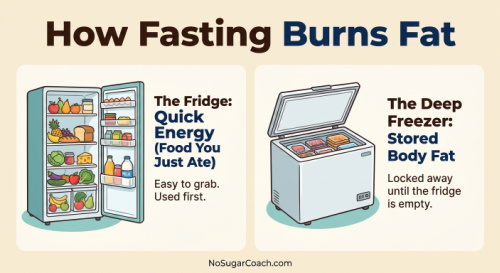
Fasting expert Dr. Jason Fung uses a great example to explain how this works. Think of your body like a kitchen with a fridge and a deep freezer in the basement.
- The Fridge: This is the food that's easy to grab.
- The Deep Freezer: This is your stored body fat.
If you keep grabbing snacks from the fridge every few hours, your body has zero reason to walk down to the basement and open the deep freezer. Fasting simply stops you from restocking the fridge for a little while. Suddenly, your body says, "Well, the fridge is empty now. Time to go downstairs and grab some fat."
If you struggle with stubborn weight, lowering the hormone insulin is huge. You can read more about how this works on my Insulin Resistance page.
What Can Break a Fast?
This is the number one question people ask. Here is the simple answer. If it has calories or triggers an insulin response, it breaks your fast.
The "Yes" List (Keep Fasting):
- Plain water: Flat, bubbly, warm, or ice cold. Drink as much as you need.
- Black coffee: Yes, just black. For some it’s an acquired taste but your taste buds will adjust. You’ve done harder things in your life. You can manage a black cup of coffee.
- Plain tea: Green, black, or herbal tea with nothing added.
- A pinch of salt: Put a tiny pinch of sea salt in your water or under your tongue. It can help with headaches and keeps your energy up.
The "No" List (Breaks Your Fast):
- Sugar, honey, maple syrup, or agave.
- Milk, half-and-half, and sweet coffee creamers.
- Fruit juice or regular soda.
- "Just one bite" of your spouse’s leftover toast. (Yes, your body still counts that!)
What About Cream or Butter in Coffee?
Some people love putting heavy cream, butter, or MCT oil in their morning
coffee. Technically, those calories break a pure fast. But because pure fat
doesn't spike insulin, it still keeps you in fat-burning mode. If that gets you
through the morning, go for it! In fact, that's the exact idea behind a fat
fast,
which is great if you hit a weight loss plateau.
Your Easy 3-Step Beginner Plan
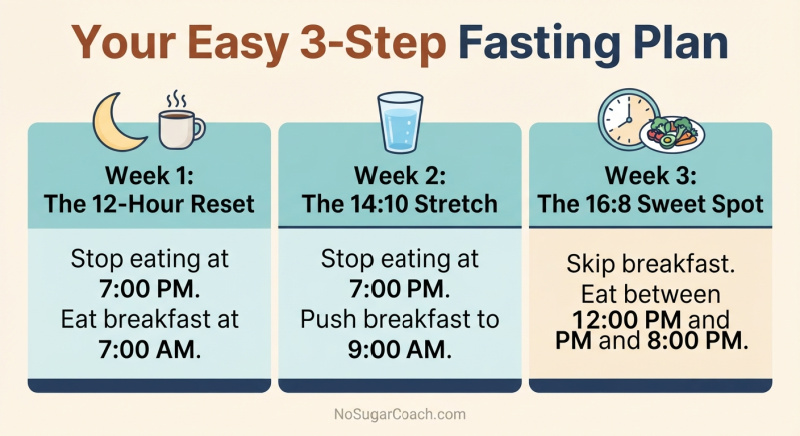
Please don’t just jump straight into a 24-hour fast on day one. That’s just a sure-fire way to become very grumpy very fast. Instead, ease into it over three weeks.
Week 1: The 12-Hour Reset
Stop eating after dinner at 7:00 PM. Then simply don’t eat
again until breakfast at 7:00 AM.
That’s it. No more late-night popcorn on the couch. Just doing this gives your
digestive system a massive break and helps tame the Food Addiction monster that loves to whisper sweet nothings in your ear at 9:00 PM.
Week 2: The 14:10 Stretch
Keep your 7:00 PM cutoff time but wait to have breakfast until 9:00 AM. You’re now fasting for 14 hours and eating within a 10-hour window. Drink a big glass of water when you wake up to keep your stomach happy.
Week 3: The 16:8 Sweet Spot
This is the most popular routine out there. You fast for 16 hours and eat all your meals within an 8-hour window. For most people, this just means skipping breakfast, eating lunch at noon, and finishing dinner by 8:00 PM.
A quick tip on flexibility: You don’t have to fast every single day. As women's health expert Dr. Mindy Pelz teaches, women especially do best when they switch things up rather than fasting hard every day of the month. Even doing 16:8 three or four days a week brings fantastic results. Listen to your body!
Should You Cut Sugar First?
Here’s a little insider secret. Trying to fast while eating a high-sugar diet is pure misery.
When you eat sugar and refined carbs, your blood sugar shoots up like a rocket and crashes like a rock. When it crashes, you get shaky, hangry, and desperate for food.
If you clean up your diet first, fasting becomes almost effortless. When your body is used to burning fat for fuel, you don't get those wild hunger pangs. If you haven't already, check out my Keto Diet for Beginners guide to get your body ready.
Once you get comfortable with basic fasting, you might even want to explore fun short-term resets like the 3 Day Egg Fast or the Sardine Fast to really kick things into high gear.
How to Break Your Fast
(Without Attacking the Pantry)
When your eating window finally opens, you might feel like you deserve a parade (I know I do!). Don’t celebrate with a giant bowl of pasta or a sweet treat.
After a fast, your body is like a dry sponge. Whatever you eat first gets absorbed super quickly. If you hit it with sugar, your blood sugar will skyrocket which is not healthy at all. You’ll feel gross, tired, cranky and bloated an hour later.
Instead, break your fast gently:
- Start with protein and healthy fats. Eggs, chicken, beef, fish, or avocado are fantastic choices.
- Eat slowly. Give your brain twenty minutes to realize food has arrived.
Who Should Skip Fasting?
Fasting can be wonderful, but it’s not for everyone. I’m not a doctor but I do know you shouldn’t fast if you:
- Are pregnant or breastfeeding.
- Have a history of eating disorders.
- Take medications for diabetes or blood pressure (since fasting lowers both, your meds might need adjusting).
- Are under 18 years old.
So, if you plan to fast, talk to your doctor first.
Ready to Take Control of Your Cravings?
Fasting isn't about punishing yourself. It is about freedom. It frees you from constantly thinking about your next meal or snack and washing dishes multiple times a day. And although hard to believe, it leaves you feeling in better control of your real hunger.
If you try fasting and realize your hunger isn't in your stomach but seems to be mostly an emotional response to whatever’s going on in your life, you’re not alone. Take my free Food Addiction Quiz or reach out to me on my Low Carb & Keto Coaching page. We can figure it out together!
Let's go back to the HOME page.
Share With Your Friends
Site Navigation
Recent Site Updates


-
Why Keto Cycling for Weight Loss is Stalling Your Plan. So Try This.
Nov 13, 26 10:36 AM
If you're still trying to lose weight and trying to get metabolically healthy, keto cycling for weight loss may not be the right move for you just yet! -
The Sardine Fast Way to Lose Weight
Nov 13, 26 10:11 AM
The Sardine Fast AKA The 3 Day Sardine Fast is a fantastic way to lose weight quickly. Simple and uncomplicated. Learn more here. -
3 Day Egg Fast
Nov 13, 26 10:06 AM
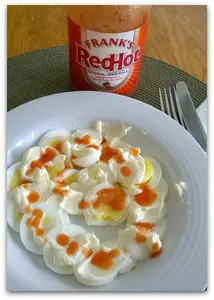 Is the 3 Day Egg Fast right for you? Maybe yes. Maybe no. Here's what you need to know. Read this before venturing down this path.
-
What is a fat fast? It's extreme and it's effective. Worth a shot!
Nov 13, 26 10:02 AM
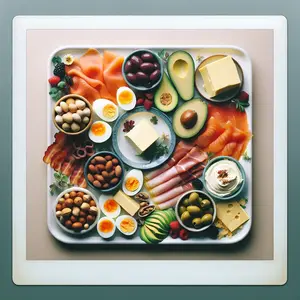 What is a fat fast? It's like a ketogenic diet in overdrive. It gets you in ketosis promotes fat burning. Weight loss plateau? Try this approach.
-
I'm Cheryl Poulin, a Professional Food Addiction Counselor
Aug 22, 26 11:19 AM
 I'm Cheryl Poulin. I help people overcome weight-loss resistance, so they can experience optimal health, wear the clothes they want, and make peace with food.
-
What Is Body Dysmorphic Disorder -Phantom Fat -The Mirror Has 2 Faces
May 31, 25 05:17 PM
 What is body dysmorphic disorder? Maybe you’ve lost weight but still feel “big,” or perhaps you’ve gained weight but see yourself slim as always.