How Much Protein Do I Need A Day Calculator
Protein: Are We Getting Enough, or Have We Gone
Overboard?
It seems you can't walk down a grocery store aisle these days without being reminded that you need more protein.
Protein bars, protein cookies, protein chips, protein cereals, protein puddings. Even products that never needed a protein makeover are suddenly sporting big, bold protein claims on their packaging.
Apparently, everything needs more protein!
And while protein is certainly important, particularly as you get older, it's worth asking a few questions. How much do you actually need? Are you getting enough from the foods you eat? And has the protein craze gone a little overboard?
Let's take a closer look.
First Things First: Why Do You Need Protein?
Protein is one of the two essential macronutrients your body needs, along with fat. (Carbohydrates are commonly classified as a third macronutrient, but unlike protein and fat, they aren't considered essential because your body can produce the glucose it needs.)
Protein is made up of smaller building blocks called amino acids. Your body uses these to build and repair muscle, maintain tissues, produce enzymes and hormones, and support immune function.
In other words, protein isn't just about building bigger muscles or recovering after a workout. It's essential to keeping your body functioning properly.
How Much Protein Do You Really Need?
This is where things get interesting. The recommended amount isn't necessarily the same as the amount that might be beneficial for everyone.
The commonly quoted minimum recommendation for adults is 0.8 grams of protein per kilogram of body weight per day.
But, this is generally considered enough to meet basic requirements. It isn't necessarily the optimal amount for maintaining muscle and strength as you age.
Some experts recommend that healthy older adults aim for approximately 1.0 to 1.2 grams per kilogram of body weight daily.
Let's put that into perspective.
Someone weighing 150 pounds (approximately 68 kilograms) would need:
- 54 grams daily at 0.8 grams per kilogram.
- 68 grams daily at 1.0 gram per kilogram.
- 82 grams daily at 1.2 grams per kilogram.
That's quite a difference!
One important consideration: If you're carrying extra body fat, using your current weight to calculate your protein requirements may give you an unnecessarily high target. Depending on your circumstances, goal weight or adjusted body weight is more appropriate.
Your individual needs also depend on your health and activity level.
How to Calculate Your Own Protein Needs
Here's the simplest way to do it.
Step 1: Convert your weight from pounds to kilograms by dividing your weight in pounds by 2.2.
Step 2: Choose a protein target.
As a general starting point:
- 0.8 g/kg: Basic adult protein requirement.
- 1.0 g/kg: A higher target.
- 1.2 g/kg: A commonly suggested target for healthy older adults.
Step 3: Multiply your weight in kilograms by your chosen target.
That's your approximate daily protein target in grams.
Let's use someone weighing 180 pounds as an example and opt for the two higher targets.
180 ÷ 2.2 = 81.8 kg
At 1.0 g/kg:
81.8 × 1.0 = 82 grams of protein daily.
At 1.2 g/kg:
81.8 × 1.2 = 98 grams of protein daily.
Here's a Little Cheat Sheet
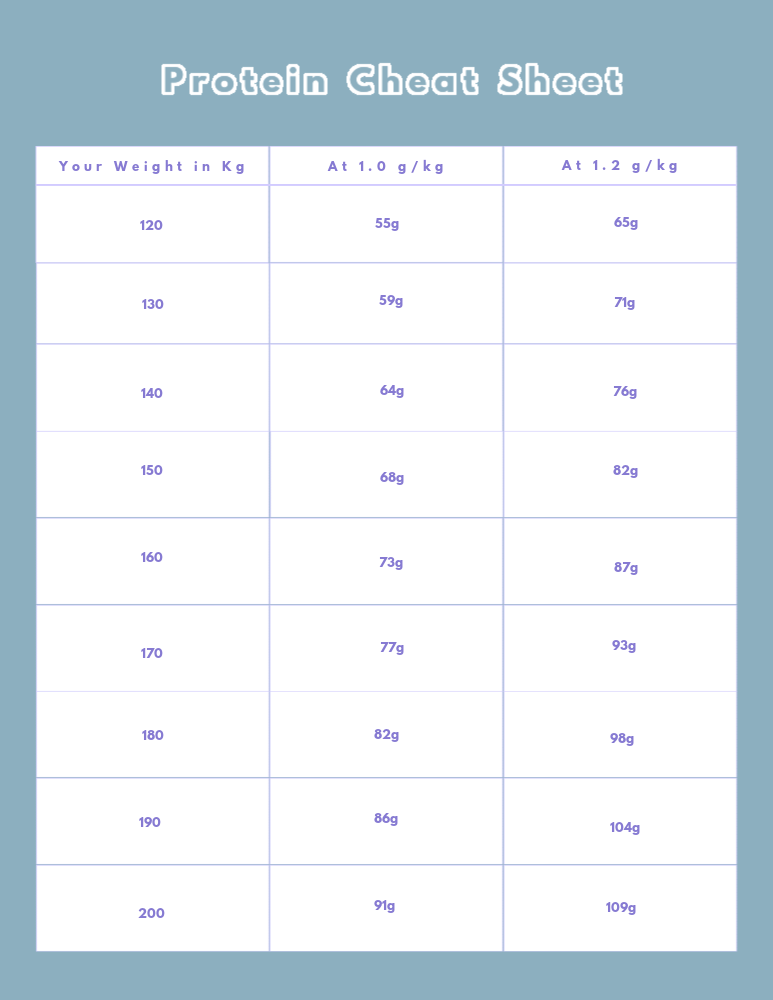
These examples use actual body weight. For someone carrying significant excess weight, actual weight may not be the appropriate number to use. A dietitian can help determine an appropriate reference or adjusted weight.
A word of caution: These are general guidelines, not prescriptions. If you have kidney disease or another condition affecting protein requirements, get individualized advice.
Share With Your Friends
Site Navigation
Recent Site Updates


-
Why Keto Cycling for Weight Loss is Stalling Your Plan. So Try This.
Aug 23, 26 09:18 AM
If you're still trying to lose weight and trying to get metabolically healthy, keto cycling for weight loss may not be the right move for you just yet! -
I'm Cheryl Poulin, a Professional Food Addiction Counselor
Aug 22, 26 11:19 AM
 I'm Cheryl Poulin. I help people overcome weight-loss resistance, so they can experience optimal health, wear the clothes they want, and make peace with food.
-
What Is Body Dysmorphic Disorder -Phantom Fat -The Mirror Has 2 Faces
May 31, 25 05:17 PM
 What is body dysmorphic disorder? Maybe you’ve lost weight but still feel “big,” or perhaps you’ve gained weight but see yourself slim as always.
-
The Sardine Fast Way to Lose Weight
May 31, 25 12:21 PM
 The Sardine Fast AKA The 3 Day Sardine Fast is a fantastic way to lose weight quickly. Simple and uncomplicated. Learn more here.
-
3 Day Egg Fast
May 12, 25 09:05 AM
 Is the 3 Day Egg Fast right for you? Maybe yes. Maybe no. Here's what you need to know. Read this before venturing down this path.
-
Here are Cheryl Poulin testimonials.
May 04, 25 09:46 AM
 Here's what some of my clients have had to say about working with me as their personal coach.